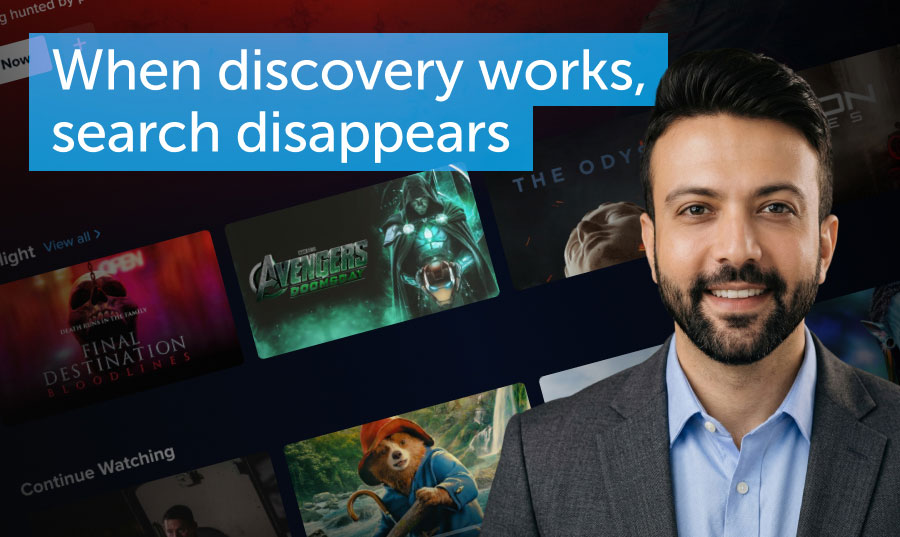
When discovery works, search disappears
April 13, 2026 | 3 min readBy Varun Mishra
Streaming platforms were built for a world where search made sense. Users opened an app, looked for a title, browsed a few rows, and made a choice.
That is not how digital behavior works today.
User expectations have evolved faster than streaming interfaces.
Social platforms such as TikTok, Instagram, and YouTube have trained users to expect discovery that is immediate, personalized, and low effort. Deloitte reports that a majority of Gen Z and millennial audiences now say they get better recommendations from social media than from streaming services. The same research shows Gen Z spends significantly more time on user-generated video while spending less time on traditional TV and movies.
This shift is not about format. It is about expectation. Users increasingly expect the platform to guide them.
Search still has value when intent is clear. But it is no longer an effective primary mechanism for discovery. Most viewing sessions do not begin with a specific title. They begin with partial intent: a mood, a genre, a live event, or simply the desire to find something quickly.
When platforms rely on search and static navigation, friction becomes visible. Nielsen’s 2025 Gracenote research found that 45% of viewers say the streaming experience is overwhelming. Viewers spend an average of 14 minutes searching for something to watch, and 19% abandon a session if they cannot find something quickly, rising to 29% among viewers aged 18 to 24. Nearly half say they will consider canceling a service if discovery remains difficult.
This is not a content problem. It is a discovery problem.
The industry has spent years expanding catalogs, adding services, and increasing choice. More content, however, does not automatically improve the experience. In practice, it increases decision pressure. Gracenote’s State of Play highlights this as a discovery challenge in a fragmented market, where audiences would rather “open one door” to reach what they want than navigate across many.
The strongest platforms address this directly. They reduce effort, narrow choices, guide attention, and help users move from uncertainty to confidence quickly.
Netflix is a strong example. Its recommendation system personalizes not just titles, but the rows shown on the homepage, the titles within those rows, and their order. Personalization is not only about what is suggested, but how the entire discovery journey is structured for each user.
That is the direction the MK.IO Platform is heading.
For us at MediaKind, the future is not a static platform with the same home screen and navigation logic for every user. It is a discovery-led experience shaped around individual intent and behavior. This requires continuous learning, with models adapting content priorities, rankings, and journeys dynamically based on what is most relevant for each user. Research also shows that subscribers already exposed to AI want more of it. Hub Entertainment reports that among current AI users, 84% are interested in better recommendations, 78% in systems that remember what they intended to watch, and 72% in tools that help multiple viewers decide what to watch together.
This is where the MediaKind MK.IO Platform is focused.
We are building a system where discovery is proactive, not reactive. Content is surfaced based on real-time context, behavior, and preferences, not just past viewing history. The interface adapts continuously, guiding users toward relevant content with minimal effort and reducing the need to search altogether.
The platforms of the future treat discovery the way TikTok does, as a foundational capability. We believe all streaming and Pay TV platforms can benefit from this approach.
If this resonates, join us at NAB and experience our AI-driven discovery demos at the MediaKind booth W1743.
Discover MK.IO Platform
Explore how the MK.IO Platform is built for scale, delivering seamless performance to millions of users, even at peak demand.