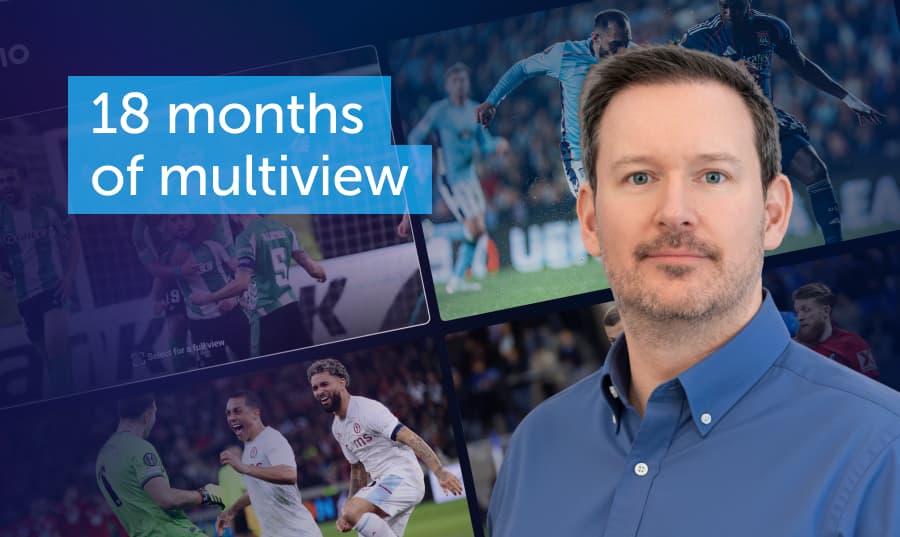
Multiview: From experiment to behavior shift
April 16, 2026 | 2 min readBy Paul O’Donovan
A little over 18 months ago, Multiview wasn’t a product category for us. It was an experiment.
The idea was simple: take a capability traditionally tied to high-end set-top boxes and move it into the cloud, fully virtualized and elastic. For live sports, that immediately changed the economics. Instead of building for peaks and carrying that cost year-round, operators could deploy Multiview when it mattered most, during the moments that drive the highest audience demand.
The first real test came with Comcast in the fall of 2024. We launched a static, curated Multiview experience in production. It was simple to discover, simple to use, and designed to scale. Comcast’s rollout allowed X1 customers to watch up to six live games on a single screen. During the 2024–25 NFL season, the value was obvious. With dozens of games every weekend, fans discovered a new way to follow multiple games without constantly switching.
What began as a controlled rollout quickly proved something bigger. Through the MK.IO cloud, Multiview was delivered to more than 10 million X1 customers, supporting hundreds of live regional channels with cloud-scale elasticity and geo-redundant resiliency. Consumption ramped quickly, with usage more than doubling year over year.
That was the first proof point. Static Multiview worked, and it worked at scale. However, it was still curated. Layouts were predefined. Choices were limited.
So, we built Elastic Multiview.
In late 2025, Comcast introduced “Create Your Own Multiview,” allowing viewers to select a layout and choose from tens of games, dynamically rendered and streamed in real time. This marked the shift from fixed options to user-driven combinations within a flexible framework. The number of possible combinations grew exponentially, effectively becoming unlimited. Adoption accelerated. Viewers began following multiple games, angles, and storylines simultaneously. What started as a curated feature evolved into a real-time personalization layer for sports fans.
Across our North American deployments today, MK.IO Multiview reaches more than 20 million subscribers, drives tens of millions of viewing hours, and dynamically combines well over 1,000 live regional channels. In one recent sporting event alone, more than 500,000 Multiview viewing hours were recorded.
These are not pilot metrics. They are production realities.
By early 2026, a more important shift became clear: Multiview wasn’t just growing, it was changing behavior. During the Milan Cortina 2026 Winter Olympics, NBCUniversal expanded Multiview as part of a broader interactive experience and reported that among users engaging with Multiview, consumption nearly quadrupled. Multiview has evolved into a powerful navigation layer for live content.
We saw the same pattern during March Madness, when Charter recently launched Multiview for the NCAA basketball tournaments, giving customers the ability to watch multiple games simultaneously. Adoption grew rapidly, with hundreds of thousands of Multiview hours delivered within days post-launch.
What have we learned in our 18-month journey?
The Pay TV industry is often described as mature, with limited innovation and incremental progress. The MK.IO North American Multiview deployments suggest otherwise.
Rapid change is possible when cloud economics, real-time processing, and user control come together. In just 18 months, a simple experiment evolved into a new interaction model for live sports.
And it’s still early.
Discover Multiview with MK.IO
Explore how MK.IO Multiview delivers scalable, real-time streaming, enabling seamless viewing of multiple live sports at once.