
The economics of hybrid streaming architecture for cost optimization
September 2, 2025 | 3 min readStreaming viewership continues to grow globally. This trend increases the importance of streaming cost optimization for service providers. In the U.S., Nielsen’s The Gauge highlights rising consumption. In Europe, TF1 and RTL reported nearly 30% year-over-year growth in digital ad revenue across their streaming platforms in Q1 2025.
At the same time, many streaming platforms remain unprofitable. They still require significant investment. This investment supports innovation in user engagement, monetization, robustness and operational efficiency.
Because of this duality, service providers and broadcasters are seeking cost-effective, future-ready solutions. These solutions help them upgrade their streaming platforms.
This blog explains how to optimize the streaming video pipeline. It covers ingest, processing and delivery to the CDN. The goal is to reduce costs for telcos and cable operators. At the same time, platforms must remain flexible to support new capabilities.
TCO of key components in the streaming video pipeline
Streaming workflows can run in the public cloud or on-premises. Both options deliver similar technical performance. Therefore, the decision is mainly a business choice.
Several components make up a streaming video pipeline. Platforms ingest linear channels and VOD assets. They also transcode, encrypt and package content. VOD, live-to-VOD and nPVR assets are encoded and stored. Origin servers are another critical element. They connect the platform to the CDN.
This analysis focuses on telcos and cable operators. In this context, origin servers mainly feed the operator’s on-net CDN.
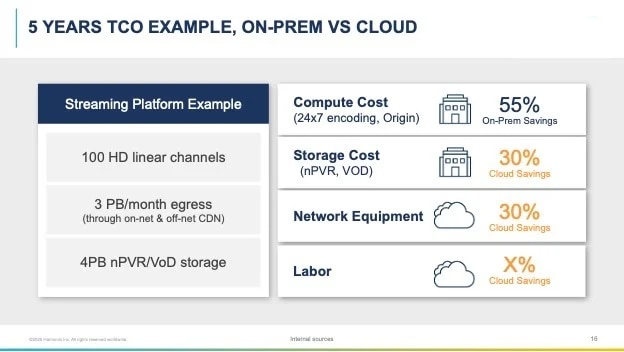
We compare storage, compute and networking costs. The comparison covers cloud and on-premises deployments over five years. The model assumes 100 HD linear channels encoded in MPEG-4 AVC. It includes 4 PB of storage for nPVR and VOD. It also includes 50 PB of monthly egress across on-net and off-net CDNs.
For the on-premises scenario, several costs are included. These include electricity, cooling, racks, SLA and professional services. All costs are calculated over five years. However, they may vary by region.
The cloud scenario assumes reserved compute resources. These resources are committed for five years.
The table below presents the results of this TCO analysis.
Comparing costs and defining a hybrid streaming strategy
Labor cost savings can vary significantly. Some operators can share engineering teams across multiple activities. These include network, IT, video platforms and back-office operations. Others cannot.
Compute resources for 24/7 linear encoding and origin are relatively stable over time. As a result, they are often more cost-effective when deployed on-premises.
The TCO analysis also shows that the public cloud is efficient for storage and networking. This efficiency comes from economies of scale. It also reflects the experience cloud providers have in managing large data volumes. This trend continues to grow with AI.
Telcos and cable operators must also consider egress costs. These costs apply when feeding their on-net CDN from the public cloud. They should be included in the overall TCO.
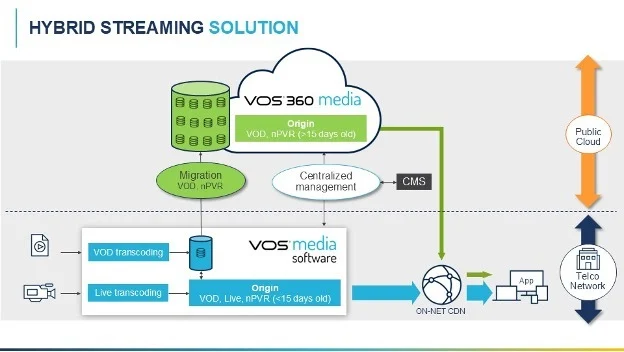
Based on these factors, a hybrid model is a logical approach. It helps optimize the TCO of the streaming video pipeline. This model orchestrates content across on-premises and public cloud resources, as shown in the diagram below.
How hybrid streaming architecture works in practice
All linear channel encoding is performed on-premises. Some on-premises resources also handle business-as-usual file transcoding. On-premises storage is limited to recent content. This includes fresh VOD, nPVR and catch-up TV assets.
The on-net CDN pulls newly released and popular content directly from on-premises origin servers.
As content ages, it is automatically moved to the public cloud. It is then stored in cold storage to reduce costs. Egress costs remain low because this content is accessed less frequently.
This hybrid streaming architecture is cost-efficient. It also gives service providers flexibility. They can shift workloads to the public cloud when needed. This is especially useful during peak demand, such as major live sports events.
In addition, MediaKind’s hybrid streaming solution improves disaster recovery. It protects on-premises infrastructure and helps maintain service uptime during major failures.
A key component of this solution is the central management system. It ensures smooth operations across on-premises and cloud environments. This is made easier because VOS360 Media and VOS Media Software share the same API and software foundation.
Central orchestration automates content migration from on-premises to the cloud. It uses rules based on content freshness and popularity. The process is transparent to the content management system (CMS), ensuring seamless operations.
The central management UI allows operators to create, configure and monitor linear channels. They can decide whether to run them on-premises only. Operators can also add temporary cloud resources when needed. This helps handle peak demand, such as major live events. It also supports large-scale transcoding projects, like onboarding a full content library from a partner such as Disney+. This approach avoids costly overprovisioning of on-premises resources.
Future-proof streaming starts with a hybrid foundation
Hybrid streaming helps service providers improve efficiency and reduce costs. It also enables them to scale across cloud and on-premises environments. By partnering with MediaKind, they can accelerate this transformation. MediaKind’s SaaS and software solutions simplify operations through central orchestration. They also enhance viewer experiences and provide the flexibility needed in a rapidly evolving media landscape.