When the world is watching, scale is only the beginning
October 5, 2026 | 4 min readWhat the 2026 World Cup taught us about live streaming resilience, operational readiness and the future of video delivery.
Twenty-five million concurrent viewers is the kind of number that commands attention. But when MediaKind reviewed its work across the 2026 World Cup, another figure told an equally important story: 1,784 streaming events generated from 104 matches.
Those figures describe two different challenges. One is delivering a popular stream to millions of people at once. The other is preparing and operating thousands of streams across customers, regions, services and devices. A platform must handle both while giving fans the experience they expect when the match begins.
25M
Concurrent viewers
1,784
Streaming events
104
Matches
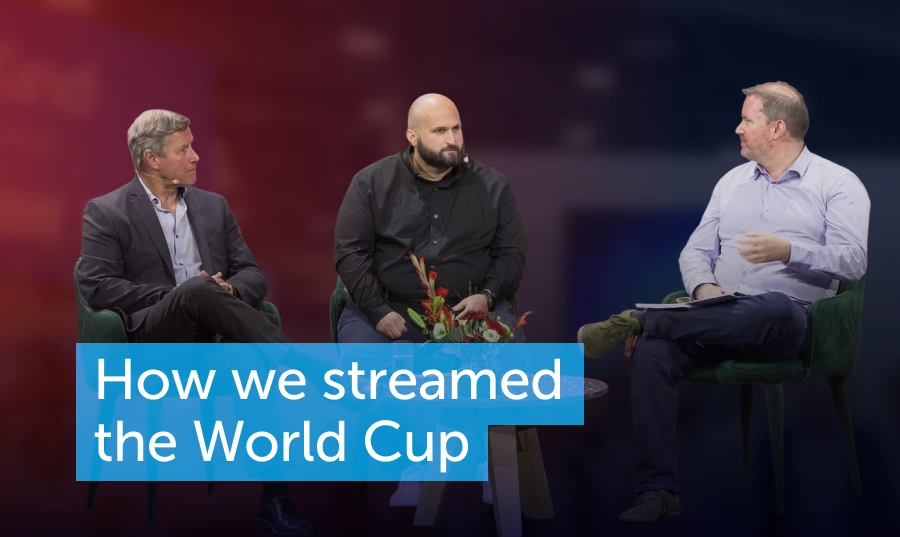
At IBC, MediaKind CTO Cory Zachman joined Akamai Chief Architect Will Law and moderator Paul O’Donovan to discuss what that takes in practice.
The work starts before the first viewer arrives
Live sport puts extraordinary pressure on infrastructure because audiences arrive together. Every additional stream also needs compute capacity, configuration and a path through the delivery chain. Cloud resources can scale, but they still need to be planned.
For MediaKind, that means working closely with infrastructure partners ahead of an event: checking available capacity, API limits and the ability to start large numbers of streams at once. For Akamai, it means planning how traffic will move from origins through its distribution network and into the internet service providers serving viewers.
“You can’t dynamically create the architecture when a major event begins. You have to plan for it well ahead of time.”
Will Law
Chief Architect Akamai
The scale is substantial. Akamai reported a peak of 201 terabits per second during the World Cup final, across 55 broadcasters using its network to stream the match. Delivering that traffic reliably depends on more than adding capacity. It depends on placing it where viewers will need it and avoiding congestion along the way.
Resilience must run through the whole workflow
No team can perfectly reproduce a World Cup audience in a test. Simulated viewers behave differently from people watching on home broadband and mobile networks around the world. Testing remains essential, but the architecture must also be ready for conditions the test did not reveal.
“It’s very difficult to test a real event without a real event. You can get close, but actual viewers and networks never behave exactly like a simulation.”
Will Law
Chief Architect Akamai

MediaKind builds safeguards throughout the video workflow: redundant inputs, encoding across regions, packaging that can scale with demand, and caching layers that help protect origins. The team also prepares ways to reduce pressure if a service is under strain, such as adjusting the bitrate ladder or disabling a feature where the customer has agreed that trade-off in advance.
“We build resilience and elasticity into every step of the video workflow. The goal is to handle the demand we expect and have safeguards in place for the demand we don’t.”
Cory Zachman
CTO MediaKind
These decisions cannot be improvised during a match. Customers have different requirements, so MediaKind’s operations and engineering teams agree on response procedures with them beforehand, rehearse likely failure scenarios and make sure the right telemetry is available to identify a problem quickly.
That is why the service behind a video platform matters as much as its software. Support teams monitor streams and alerts throughout an event, with engineers ready to join in real time. When seconds count, a practiced procedure gives the people operating the service a clear way to act.
Major events also attract traffic intended to disrupt them. Will described attacks during the tournament, underlining why security belongs in the same operational plan as capacity, monitoring and recovery.
Bringing more of the delivery chain together
The discussion also showed how the MediaKind and Akamai partnership is extending beyond delivery. Akamai’s MSL5 live origin is powered by MediaKind technology and operated by Akamai. It brings MediaKind’s media capabilities into Akamai’s cloud and delivery environment, including support for low-latency streaming and live archive use cases.
The next step discussed at IBC is adding transcoding capabilities alongside origin and delivery. Bringing more of the workflow into the same environment can reduce the boundaries a stream must cross and make the overall service simpler to operate.
For customers, the value extends beyond having more capabilities in one place. Fewer hand-offs mean less duplicated operational work and a clearer view of the service when teams need to scale it, diagnose a problem or recover from a failure.
There is a longer-term opportunity, too. The World Cup figures prompted a question: when several services carry the same underlying event, how much processing and delivery work can be shared? Cory and Will discussed ways to avoid repeating work unnecessarily, as well as emerging approaches such as Media over QUIC that could eventually give operators more flexibility over media, data and interactive elements. Those ideas are promising areas of exploration, rather than commitments for the next major event.
The measure that matters to fans
Viewers do not see the capacity planning, caches, dashboards or rehearsed response plans. They see whether the stream starts when the match does, stays on, looks good and keeps pace with the action.
“There’s no magic answer to delivering a better viewing experience. It takes hard work and engineering innovation, year after year, event after event.”
Cory Zachman
CTO MediaKind

As audiences and expectations grow, delivering that experience takes engineering across the entire chain, close partnership between providers, and experienced people ready to act when live conditions change. The headline numbers show how far streaming has come. The work behind them is what keeps fans watching.