
Right content, right place: The case for hybrid streaming
August 18, 2026 | 4 min readBy Paul O’Donovan
Streaming is where Pay TV operators are growing. It is also where costs can get out of hand quickly. Scale it the wrong way and the economics can unravel fast. A hybrid streaming approach can help keep those costs under control.
Retail and logistics solved a similar problem years ago. The best-selling products sit close to customers in local fulfilment centres, so they can be delivered quickly and cheaply at high volume. The long tail sits in larger central warehouses, where storage is more efficient and slower access is acceptable. Hybrid streaming applies this same principle to video delivery.
Streaming content behaves in much the same way.
Operators already have many of the assets that make profitable streaming possible. Broadband and mobile networks. On-net CDN. Deep experience running services that need to stay up. Scaling streaming needs to be done in a way that keeps the economics under control.
That is where a hybrid approach makes sense.
Hybrid streaming combines on-premises infrastructure with cloud resources, placing different content in the environment that best balances performance and cost.
The economics are not evenly spread
Most streaming catalogues are lopsided. A small slice of content, often around 5-10% drives most of the delivery traffic. The rest sits in the long tail. It may be watched rarely, but it still needs to be stored, managed and made available.
That creates a problem.
Build everything on premises, sized for peak and fully duplicated for resilience, and operators pay for capacity that spends most of its life waiting to be used. Move everything to the cloud and the most popular content racks up egress costs every time someone presses play.
Neither extreme really reflects how streaming services behave.
Right content, right place, right time: hybrid streaming
The practical answer is to put the right content in the right place at the right time.
Hot content should stay close to the viewer, on premises and on net, where operators can use the network assets they already own. Cold content can move to the cloud, where it can be stored at scale and brought back when demand returns.
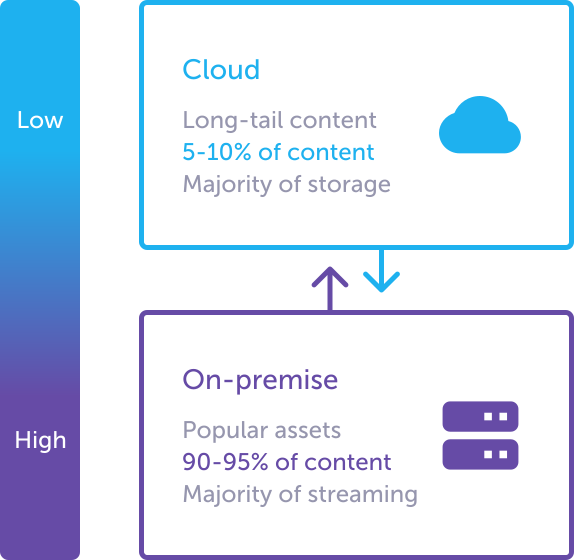
In practical terms, that means live, catch-up, fresh nPVR and recently ingested VOD remain on the high-performance origin. Older VOD and archive nPVR move to cloud storage that does not need to be sized like the delivery path.
That on-premises layer matters because high-demand streaming is not just a storage problem. When live channels, catch-up, fresh nPVR and popular VOD are being requested at scale, the origin has to deliver high throughput consistently and efficiently.
VOS on-prem origin and storage are designed for that kind of workload. They reduce unnecessary I/O, make better use of storage, and give operators the cost and performance balance they need for services running at real scale. For the content viewers are actually watching, keeping it close to the network is not legacy thinking. It is good engineering and good economics.
The result is a cost model that follows real consumption, rather than worst-case assumptions.
Instead of treating every asset as if it needs the same performance, resilience and delivery profile, operators can reserve high-performance origin capacity for the content that needs it most. Lower-demand assets can sit in more cost-efficient storage until viewing patterns change.
That changes the economics without compromising the service. Compute, storage, power, maintenance, traffic and SLA planning are aligned to how the platform is actually used, not to a theoretical peak across the whole catalogue.
Simplicity is the part people underestimate
The obvious concern is complexity. Hybrid can sound like two environments to run instead of one. More systems. More handoffs. More places for something to go wrong.
That is true if the operating model is fragmented. It does not have to be.
The MediaKind VOS platform connects on-premises and cloud environments into a single operating model.
Central Management gives operators one application for configuration, monitoring and asset movement across multiple VOS clusters.
Dashboards adds the operational detail needed to run a live service properly, from origin and live metrics to caption errors and ad-insertion visibility.
It is one framework, not a drawer full of disconnected tools.
The Intelligent Asset Movement Engine decides where each asset should live.
Origin Heat measures how often an asset is requested over time, the streaming equivalent of watching what is selling. As demand cools, the asset moves to cold storage. If interest returns, it moves back.
Operators can set explicit rules or let the system make decisions based on real demand. No quarterly migration project. No manual scripts. No operational guessing game.
Modernise streaming without losing control
Pay TV operators need cloud agility and on-premises economics. For a long time, these have been trade-offs.
Hybrid streaming is how operators stop trading them off.
Hot content stays close to the viewer. Cold content costs less to keep. The operation remains manageable. Costs follow real demand instead of theoretical peak load.
The hybrid model is the sensible way to modernise streaming.
Discover VOS Media Software
Learn more about the world’s leading cloud streaming platform.